
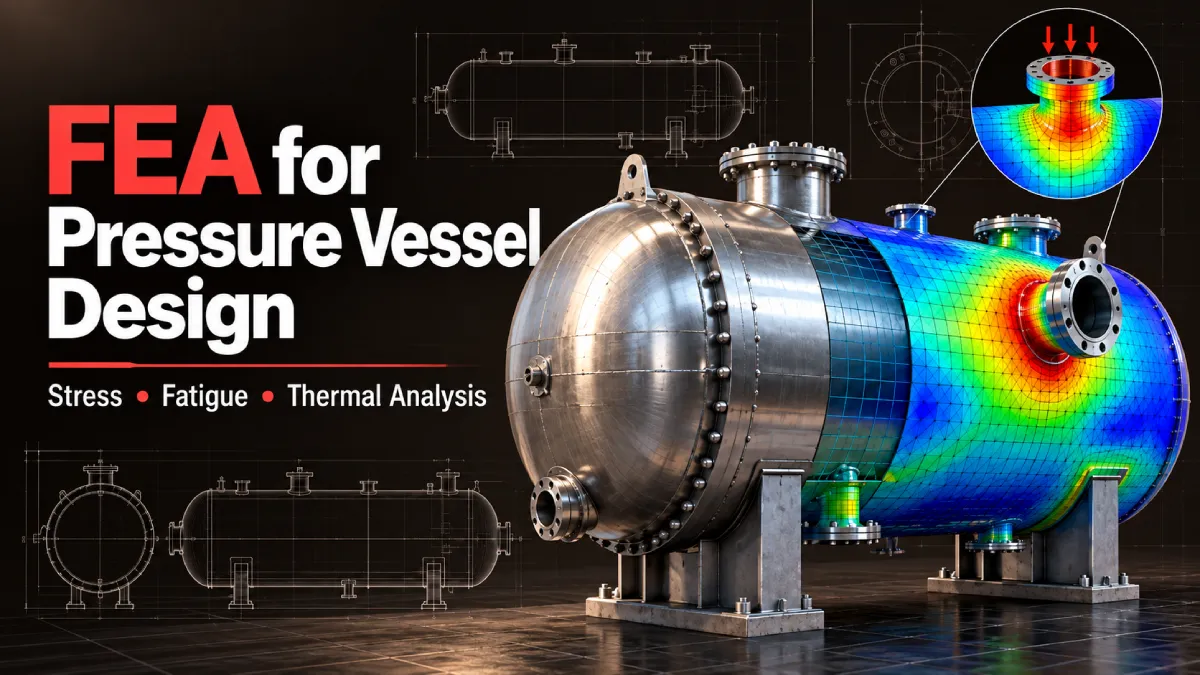
Pressure vessel FEA is a numerical engineering method used to evaluate how a pressure vessel responds to internal or external pressure, thermal loading, structural loads, and repeated operating cycles before the design reaches manufacturing or service. It helps engineers identify areas of high stress, deformation, fatigue risk, buckling susceptibility, and other potential failure conditions.
For pressure vessels, Finite Element Analysis (FEA) services can be particularly valuable when geometry, loading conditions, materials, or operating cycles make conventional calculations insufficient to understand the full structural response.
A pressure vessel design analysis may examine burst pressure, fatigue cracking, thermal stress, buckling, and localized stresses around features such as nozzles and connections. The results can then support engineering decisions and, where applicable, code-compliance assessments.
Why Pressure Vessels Need Dedicated FEA
Pressure vessels operate under loading conditions that can create complex stress distributions. Internal pressure may produce significant membrane and bending stresses, while openings, welds, supports, changes in geometry, and thermal gradients can create localized effects.
A dedicated pressure vessel FEA approach helps engineers investigate these conditions in greater detail than a simplified calculation alone.
As part of a broader Design Analysis program, FEA can be used alongside other simulation methods to evaluate structural performance and support engineering design decisions.
Failure Modes Specific to Pressure Vessels
A pressure vessel design may need to be evaluated for several potential failure mechanisms, including:
- Burst or excessive pressure loading: Determines whether stresses and deformation remain within acceptable limits under specified pressure conditions.
- Fatigue: Repeated pressure cycles, temperature changes, and operating conditions can contribute to fatigue damage over the vessel’s service life.
- Buckling: External pressure, compressive loading, or geometric instability can create buckling risks, particularly in thin-walled components.
- Nozzle and opening stresses: Connections and openings can create local stress concentrations that require detailed assessment.
- Thermal stress: Temperature gradients and repeated thermal cycles can create additional stresses even when mechanical loading remains unchanged.
- Support and attachment loading: Vessel supports and attached components can introduce localized loads into the shell.
FEA allows these conditions to be represented through appropriate geometry, material properties, loads, constraints, and operating scenarios.
Where Code Compliance Comes In
Pressure vessel engineering is often performed within established design and safety frameworks. Depending on the project, applicable requirements may include standards such as ASME Section VIII or the Pressure Equipment Directive (PED) for relevant European applications.
The applicable code should be established at the beginning of the project because it can influence the analysis approach, load cases, acceptance criteria, documentation, and reporting requirements.
FEA does not replace engineering judgment or applicable design codes. Instead, it can provide detailed numerical evidence to support design verification and engineering decisions.
What’s Included in a Pressure Vessel FEA Engagement?
The scope of a pressure vessel FEA project depends on the vessel geometry, operating conditions, materials, design stage, and applicable requirements.
Typical analysis activities can include the following.
Static Structural Analysis
Static structural analysis evaluates the vessel’s response to defined mechanical loading conditions.
Typical load cases may include:
- Internal pressure
- External pressure
- Dead weight
- Gravity
- Support reactions
- Equipment or attachment loads
- Other project-specific mechanical loads
The analysis can help identify stress concentrations, deformation, and areas requiring further engineering review.
Thermal Stress Analysis
Pressure vessels may experience significant temperature changes during startup, shutdown, process operation, or other operating cycles.
Thermal stress analysis can evaluate the structural response caused by:
- Temperature gradients
- Cyclic heating and cooling
- Thermal expansion
- Thermal constraints
- Combined thermal and pressure loading
Understanding these effects can be important when a vessel experiences repeated temperature cycles or significant differences in temperature across its components.
Fatigue Analysis
Fatigue analysis evaluates the effect of repeated loading over the expected operating life of the component.
For pressure vessels, fatigue considerations may arise from:
- Repeated pressure cycles
- Startup and shutdown cycles
- Thermal cycling
- Local stress concentrations
- Welded connections
- Changes in operating conditions
The objective is to determine whether cyclic loading could create a fatigue concern and whether changes to the design or operating conditions should be considered.
Non-Linear Analysis
Some pressure vessel problems cannot be adequately represented using purely linear assumptions.
Non-linear analysis may be appropriate when the project involves factors such as:
- Material non-linearity
- Large deformation
- Geometric instability
- Contact conditions
- Other non-linear structural behaviour
The appropriate analysis method should be selected based on the physical behaviour being investigated rather than applying a more complex method unnecessarily.
The Pressure Vessel FEA Process: From CAD to Final Report
A structured workflow helps ensure that the analysis reflects the actual engineering problem and produces results that can be used by the design team.
1. Geometry and CAD Intake
The process begins with the available design information.
This may include:
- CAD models
- Engineering drawings
- Vessel dimensions
- Material specifications
- Nozzle and opening details
- Support configuration
- Weld information
- Operating conditions
When a project requires modelling support before analysis, 3D CAD Modelling services can also be relevant. Simulation-ready models can help establish the geometry required for FEA and other engineering analyses.
2. Define Boundary Conditions and Load Cases
The next step is to establish how the vessel will behave under its actual operating conditions.
Relevant inputs can include:
- Internal and external pressure
- Temperature
- Thermal gradients
- Gravity
- Support conditions
- Mechanical loads
- Pressure and temperature cycles
- Other applicable loading scenarios
Clear definition of boundary conditions is essential because unrealistic constraints or loads can produce misleading results.
3. Meshing and Solver Setup
The model is then discretised into finite elements.
Mesh density should reflect the geometry and areas of engineering interest. Features such as openings, connections, sharp geometric transitions, and other areas of expected stress concentration may require greater local refinement.
The solver setup incorporates the selected material properties, loading conditions, constraints, analysis type, and relevant solution parameters.
4. Results Review and Code-Compliance Check
Once the analysis has been completed, the results are reviewed to identify significant findings.
Depending on the scope, this can include evaluation of:
- Stress distribution
- Deformation
- Temperature distribution
- Stress concentrations
- Fatigue-related results
- Buckling behaviour
- Critical locations
Where the project requires code-based verification, the results can be reviewed against the applicable design requirements and acceptance criteria.
5. Engineering Report and Recommendations
The final deliverable should clearly communicate what was analysed, how it was analysed, and what the results mean for the design.
A typical report can include:
- Analysis objectives
- Geometry and model description
- Material properties
- Boundary conditions
- Load cases
- Mesh information
- Analysis methodology
- Results and contour plots
- Critical locations
- Engineering conclusions
- Recommendations for design improvement, where required
What to Look for in an FEA Partner for Pressure Vessel Work
Choosing an FEA partner involves more than checking whether a provider offers finite element analysis.
Consider the following factors before starting a pressure vessel analysis project.
Relevant Engineering Experience
Ask whether the engineering team has experience with pressure-containing equipment and the types of loading relevant to your application.
Experience with pressure vessels, thermal loading, fatigue, non-linear behaviour, and complex geometries can be particularly relevant depending on the project.
Appropriate FEA Software
The software used should be appropriate for the analysis requirements.
The appropriate CFD software and modelling approach are determined based on the analysis requirements, helping engineers evaluate airflow, heat transfer, pressure behaviour, and overall thermal performance.
Ask which platform will be used for your specific project and whether it can handle the required structural, thermal, fatigue, or non-linear analysis.
The important consideration is not simply the software name, but whether the engineering team understands how to set up, validate, interpret, and communicate the analysis correctly.
Understanding of Applicable Codes
For regulated or code-driven pressure vessel projects, ask how the analysis will be aligned with the applicable design requirements.
The analysis scope, load cases, acceptance criteria, and reporting approach should be established before the simulation begins.
Clear Deliverables
Before starting the project, confirm what will be included in the final deliverable.
This may include:
- FEA model
- Mesh information
- Load-case definitions
- Stress and deformation results
- Fatigue results where applicable
- Engineering conclusions
- Code-related assessment
- Recommendations
- Final technical report
Validate Your Pressure Vessel Design with FEA
Pressure vessel FEA can provide detailed insight into how a design responds to pressure, thermal, structural, and cyclic loading conditions. By identifying critical stresses, deformation, fatigue concerns, and potential instability, engineering teams can make informed design decisions before a component reaches manufacturing or service.
The right analysis approach depends on the vessel geometry, materials, operating conditions, applicable requirements, and engineering objectives.
If you are developing a pressure vessel and need finite element analysis, structural validation, fatigue assessment, or thermal stress analysis, Converge ES can help define the appropriate analysis scope and deliver the engineering results required for your project.
Explore Converge ES FEA Services or contact the Converge ES engineering team to discuss your pressure vessel FEA requirements and request a project quotation.